

Competitor Comparison Series: OR & Procedural Support The first case of the day is scheduled for...
Competitor Comparison Series: People & Labor
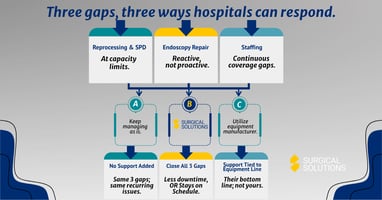
The staffing gap appears quickly at 5:45 a.m., when two sterile processing techs and a surgical technologist call out at once. The equipment manufacturer under contract can send someone to fix a sterilizer. There is no one to call for staff. By 7:30, the first case is delayed. By noon, four cases have been pushed. That scenario plays out in hospitals nationwide, and it is exactly the gap this comparison addresses.
Perioperative staffing shortages are pushing hospitals to look past their equipment vendor relationships for workforce support, and equipment manufacturers are not built to solve the problem. They design, sell, and service surgical devices. They do not recruit, train, retain, or backfill the people who run your OR and SPD every day.
Surgical Solutions does. Here is what changes across seven staffing capabilities when a hospital moves from an equipment-manufacturer relationship to an embedded, W-2 employed team.

1. Embedded On-Site Team
The gap: Equipment manufacturers dispatch technicians to service their products. No one from the equipment vendor is dedicated to your workflows, your case schedules, or your staff dynamics.
What Surgical Solutions delivers:
- A dedicated team placed directly inside your hospital, working alongside your clinical staff daily
- Deep knowledge of your surgeons' preferences, departmental rhythms, and facility-specific challenges
- Continuous operational presence, not periodic service visits
Why it matters: Hospitals that move from contract-based staffing to an embedded team typically see improvements in first-case on-time start rates and reductions in tray error rates within 90 days.
2. W-2 Employed Staff
The gap: Equipment manufacturers offering any staffing rely on agency or contract arrangements. The workers are temporary placements with divided accountability.
What Surgical Solutions delivers:
- Dedicated employees who carry consistent benefits, training standards, and performance expectations
- Staff integrated into your hospital's culture and held to the same quality benchmarks across every shift
- Reduced compliance risk from standardized credentialing and onboarding
Why it matters: Agency-style staffing often leads to higher error rates and inconsistent workflows. A team of dedicated employees managed by a single, accountable operator delivers consistency in quality, compliance, and culture that agency models cannot.
3. Recruiting, Onboarding, and Retention
The gap: Equipment manufacturers have no recruiting pipelines for perioperative professionals and no talent networks for surgical technologists, sterile processing technicians, or OR support staff.
What Surgical Solutions delivers:
- Dedicated recruiting operations built specifically for procedural support roles
- Structured onboarding programs that prepare candidates for hospital-specific workflows
- Retention strategies including career development, compensation optimization, and on-site leadership
Why it matters: Industry estimates place the cost of replacing a single surgical technologist at $30,000 to $50,000 once recruiting, training, and lost productivity are factored in. An operator with no retention strategy guarantees turnover.
4. Flexible Staffing Model
The gap: Equipment manufacturers offer rigid service contracts tied to their products. They do not flex staffing levels based on surgical volume, seasonal demand, or departmental needs.
What Surgical Solutions delivers:
- Staffing models to scale with case volume, up during peak months, right-sized during slower periods
- Workforce plans that adjust when departments restructure or service lines expand
- No long-term staffing commitments that leave a facility overstaffed or understaffed
Why it matters: OR utilization targets typically range from 70% to 85%. Staffing cannot flex to match the volume unless the facility is either paying for idle capacity or losing cases due to understaffing. Both outcomes erode margin.
5. Rapid Backfill Capability
The gap: When a staff member calls out or resigns, equipment manufacturers have no mechanism to fill the gap. They are not in the workforce business.
What Surgical Solutions delivers:
- Operational infrastructure and bench depth to rapidly backfill open positions
- Response protocols that prevent single-point-of-failure staffing gaps
- Continuity of operations even during unexpected turnover
Why it matters: Under agency staffing models, backfill timelines commonly stretch three to six weeks. Every day without a replacement means redistributed workloads, overtime costs, and delayed cases. Surgical Solutions guarantees backfill within five business days, a contractual commitment rather than a target.
6. On-Site Clinical Educator
The gap: Equipment manufacturers provide product training on their specific devices, such as how to operate a sterilizer or reprocessor. They do not provide broader clinical education for perioperative staff.
What Surgical Solutions delivers:
- On-site clinical education resources dedicated to the facility
- Continuous training, competency assessments, and skills development tailored to staff and procedures
- Proactive preparation for Joint Commission surveys and regulatory audits
Why it matters: A team with ongoing clinical education is better positioned for regulatory readiness. A team that keeps improving, rather than just showing up, protects accreditation standing and patient safety.
7. Staff Compensation Tied to KPIs
The gap: Equipment manufacturers have no framework for tying workforce compensation to hospital performance metrics. Their compensation structures are built around equipment sales and service revenue, not the OR facility's outcomes.
What Surgical Solutions delivers:
- A compensation approach that connects staff performance to measurable outcomes
- Accountability to the same metrics reported to hospital leadership: first-case on-time starts, turnover time, tray accuracy, compliance scores
- A shared-accountability model where workforce performance and hospital outcomes are aligned
Why it matters: When compensation is disconnected from outcomes, performance plateaus. Tying performance to metrics like first-case on-time starts (target: above 80%) and tray accuracy creates accountability that agency-style arrangements cannot match.
People and Labor Capability Comparison
|
Capability |
Equipment Manufacturers |
Surgical Solutions |
|
Embedded, on-site team |
— |
✓ |
|
W-2 employed staff (not 1099 contractors) |
— |
✓ |
|
Recruiting, onboarding & retention management |
— |
✓ |
|
Flexible staffing model that scales with case volume |
— |
✓ |
|
Backfill within 5 business days |
— |
✓ |
|
On-site clinical educator |
— |
✓ |
|
Staff compensation tied to KPI performance |
— |
✓ |
Full capability comparison across all five service pillars available on the [Surgical Solutions comparison page].
Frequently Asked Questions
What is the real difference between an embedded staffing model and a staffing agency?
An agency places temporary or contract workers with limited integration into a facility's culture or long-term goals. An embedded model places dedicated, W-2 employed staff who work inside the facility on an ongoing basis, with accountability tied to the hospital's own performance metrics.
How long does it take to transition from vendor or agency staffing to an embedded team?
Transition timelines vary by facility size and current staffing structure, but most engagements begin with an on-site assessment before staff placement, ensuring the team is built around existing workflows rather than disrupting them.
Does an embedded staffing model cost more than traditional OR or SPD staffing?
Not necessarily. While embedded staffing is a direct investment, it typically reduces the hidden costs of turnover, agency markups, and case delays that come with less stable staffing models.
What happens to existing hospital staff when an embedded team comes on board?
An embedded team works alongside existing staff rather than replacing them, integrating into current workflows and department culture while adding the depth needed to close staffing gaps.
The Bottom Line
Equipment manufacturers sell products. Surgical Solutions manages the workforce built to keep an OR and SPD running.
This is a structural difference, and it determines whether a People and Labor strategy produces measurable operational results or leaves a hospital managing staffing gaps with an operator that was never built to fill them. Hospitals that get this right reduce turnover, protect OR revenue, strengthen compliance readiness, and build teams that stay.
Schedule a 15-minute conversation to see how Surgical Solutions can improve your People and Labor operations.
See How Surgical Solutions Works.