


Opinion: 5 Practical Strategies to Prevent Burnout in Sterile Processing In the high-stakes world...
Accreditation 360 shifted the standard from documentation to demonstration. Nowhere does that shift show up more clearly than in sterile processing, where a surveyor tracing an instrument tray expects staff to explain the reasoning behind each step, not just point to a binder.
Sections 6.1 and 6.2 of the survey framework cover sterilization and high-level disinfection reprocessing, the two areas where surveyors spend the most time on the floor. Both sections follow the same pattern seen across Accreditation 360: fewer standards, sharper questions, and staff expected to answer them directly.

Sterilization: what surveyors look for
Surveyors start with accountability. Who owns the sterilization policy, how often it gets reviewed, and whether it reflects current manufacturer instructions for every piece of equipment in use. From there, the questions move to the floor.
Staff handling sterilization should expect to walk a surveyor through the full cycle: verifying parameters against manufacturer instructions, monitoring each load, and documenting maintenance on every sterilizer. Transport comes up too, particularly how contaminated instruments move from point of use to decontamination without compromising staff safety or instrument integrity.
Single-use device reprocessing draws close attention. Facilities reprocessing single-use items need documentation showing the reprocessing entity holds current FDA clearance, along with a policy addressing when and how those items get reprocessed. Surveyors also ask about breach response: what happens when a sterile package shows signs of compromise, and how the organization determines whether patient notification is warranted.
High-level disinfection: the endoscope question
Endoscope reprocessing gets its own line of questioning, largely because the process involves more steps and more room for variation between shifts.
Surveyors typically start at the point of use, asking how staff precleans an endoscope immediately after a procedure and how that process differs when immediate precleaning is not possible. From there, questions move through leak testing, manual cleaning, and the disinfection or sterilization step itself, with particular attention paid to whether every channel of a scope gets fully perfused during high-level disinfection.
Storage draws scrutiny as well. Surveyors want to see endoscopes hung correctly, drying completed before storage, and a documented risk assessment establishing a maximum safe storage duration. Competency assessment closes out the section, covering how often staff get evaluated on reprocessing skills and what happens when someone fails that assessment.
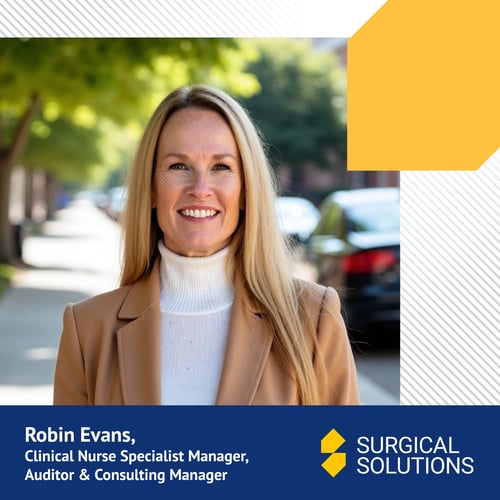
"The teams that do well under a tracer are not the ones with the thickest policy manual," said Robin A. Evans, BSN, RN, RNFA, CRCST, CHL, clinical nurse specialist manager at Surgical Solutions. "They are the ones where staff can explain what they are doing and why, at any station, on any shift."
Building the habit before survey week
Accreditation 360 rewards consistency over preparation sprints. Facilities treating sterilization and high-level disinfection as daily practice, rather than survey-week review, tend to answer these questions without hesitation because the answer is simply how the department already operates.
A readiness checklist covering both sections is available below, along with the full Accreditation 360 kit and interactive tracer walk.

Facilities looking for hands-on mock survey support can contact Surgical Solutions to get started.

.png?height=200&name=Sterile%20Processing%20(6).png)