

Accreditation surveys can feel unpredictable for hospitals preparing for a Joint Commission visit....
A New Era of Systems Thinking in Surgery
Procedural support is a team of trained specialists who work alongside surgeons and nurses to manage equipment setup, troubleshooting, intraoperative coordination, and post-procedure restocking. The goal is simple: predictable workflows, fewer delays, and better use of every surgical resource.
For decades, surgical safety rested on the skill and vigilance of individual clinicians. Today, the hospitals setting the pace look past individual performance and ask a bigger question: How well does the entire operating room system perform?
Procedural support puts the answer to work on the floor. It reflects the move away from "shame and blame" and toward systems-based quality improvement, where safe, efficient, and data-informed environments are built into every case.
Why Procedural Support Matters
Procedural support is measured by outcomes. Here is where hospitals see the difference.
-
Shorter delays and faster turnover. When equipment is ready and specialists anticipate the next step, cases start on time and rooms turn over faster. Patients wait less, and surgeons stay on schedule.
-
Sharper clinical focus. Surgeons and nurses stay with the patient instead of hunting for instruments or fixing technical issues mid-case.
-
Consistency and safety. Standardized processes lead to fewer errors. Procedural specialists hold the line on sterile technique, equipment checks and documentation across every team and shift.
-
More value from equipment. Procedural specialists bring deep experience with technologies such as robotics and endoscopy. This expertise helps hospitals protect capital investments and keep downtime low.
-
Proof in practice: In a robotics program supported by Surgical Solutions, average trays down dropped 67%, freeing sterile processing capacity and reducing waste. Read the case study.
The Evolving Role of Procedural Support
As surgery grows more complex and technology-driven, procedural support has become a strategic resource rather than a staffing fix. The best programs pair operational expertise with clinical goals.
Specialized providers now place professionals trained across multiple specialties, giving hospitals flexibility and shortening the learning curve for in-house staff.
-
How to Bring Procedural Support in Your OR
Delays, equipment issues and inconsistent processes are common signs an OR could benefit from procedural support. Start here:
- Map the workflow. Identify bottlenecks in case turnover, setup and equipment management.
- Match specialists to case mix. Prioritize dedicated specialists for the procedures performed most often, such as robotics or endoscopy.
- Choose the right partner. Surgical Solutions provides trained procedural specialists who integrate with existing surgical teams and help the OR run at full potential. Explore Procedural Support Services.
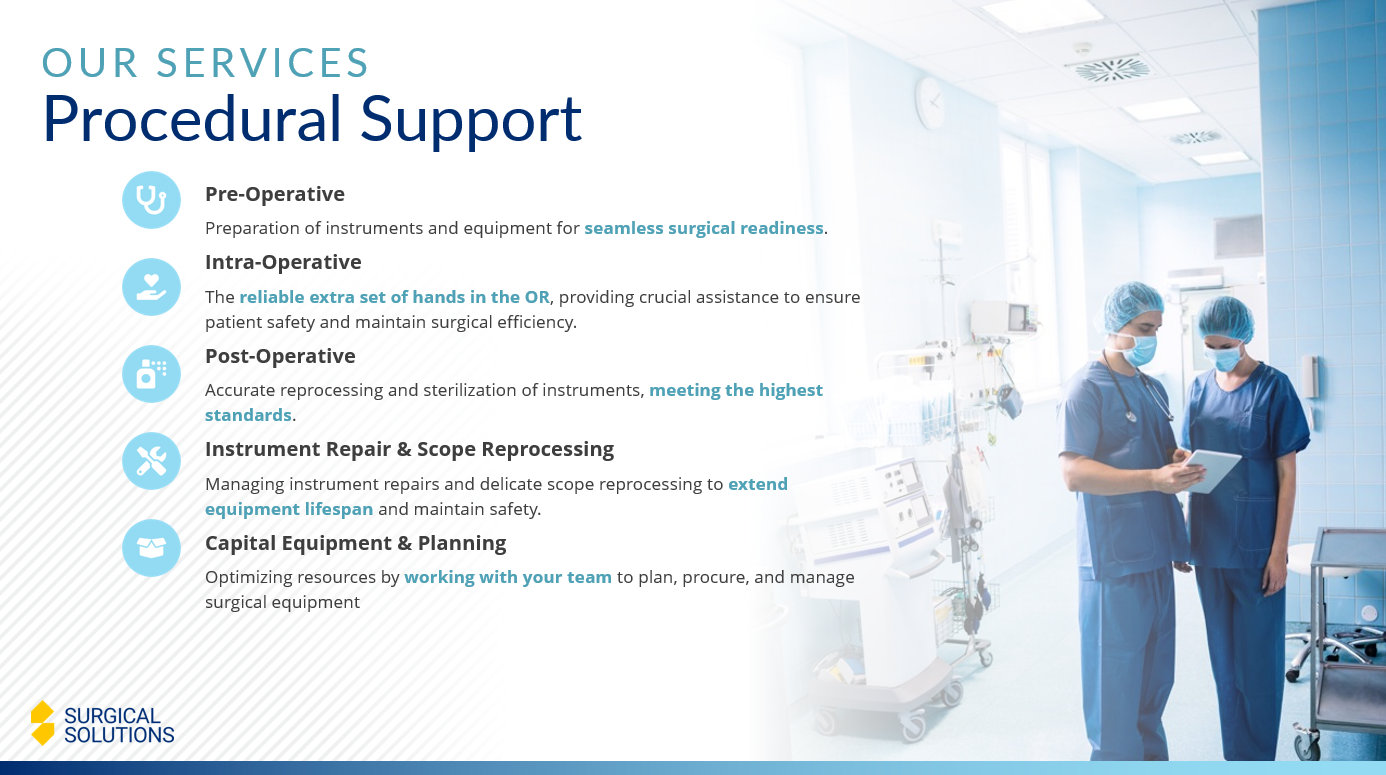
How Procedural Support Specialists Advance Healthcare Quality Improvement
Healthcare quality efforts have shifted toward improving conditions and processes, not just monitoring people. Procedural support specialists embody that philosophy in the OR by embedding process reliability and teamwork directly into every procedure.
The Agency for Healthcare Research and Quality defines six dimensions of healthcare quality. Here is how procedural support lines up with each one.
|
Quality dimension |
How procedural support contributes |
|
Safe |
Maintains sterile technique, verifies equipment and helps prevent errors |
|
Effective |
Ensures instruments and technology are used correctly for each case |
|
Timely |
Cuts setup and turnover delays between cases |
|
Efficient |
Reduces wasted time, supplies and staff effort |
|
Equitable |
Delivers the same standard of support for every patient, regardless of surgeon, shift or time of day |
|
Patient-centered |
Frees clinical staff to focus on the patient, not logistics |
Data-Driven Hospital Operations with OpsGUARD™
Great procedural support runs on data. Surgical Solutions teams track equipment utilization, turnover times and error trends to keep improving efficiency and safety for every partner hospital.
OpsGUARD, the Surgical Solutions performance tracking platform, gives leaders real-time visibility from the OR floor to the executive dashboard through three modules:
- Processes – Automates and standardizes operational audits to ensure compliance, consistent procedures, and streamlined quality reporting.
- Assets – Reduces equipment downtime and improves asset efficiency with full tracking and analytics.
- Insights – Surfaces real-time KPIs and team metrics to enable data-driven decisions and improve performance transparency.
Paired with procedural specialists, OpsGUARD closes the loop between what happens in the room and what leaders see in the numbers. Learn more about OpsGUARD.
Built for Resilience, Readiness, and the Future of the OR
Hospitals with defined support roles and strong processes are better prepared when pressure hits. Procedural support helps hospitals:
- Scale surgical capacity safely
- Adapt quickly to staffing changes
- Maintain high-quality care during surges and shortages
Quality Improvement Is a Team Sport
Quality improvement belongs to everyone, not only analysts and administrators. Procedural support is where the philosophy comes alive in the operating room.
By embedding specialized, process-driven expertise into every procedure, hospitals gain safer surgeries, stronger teams and better outcomes. Procedural support is quality improvement in action.
Frequently Asked Questions
What does a procedural support specialist do? A procedural support specialist manages the equipment and logistics behind a surgical case. Duties include room and equipment setup, troubleshooting during the procedure, coordinating with the surgical team and restocking afterward.
How is procedural support different from traditional OR staffing? Traditional staffing fills open positions. Procedural support adds specialists trained in specific technologies and workflows, with a focus on standardizing processes and improving efficiency across the department.
Which surgical specialties use procedural support? Robotic surgery and endoscopy are two of the most common, since both depend on complex equipment. Procedural support also helps in general surgery and other high-volume service lines.
How does procedural support reduce OR turnover time? Specialists prepare equipment ahead of each case, anticipate the next step and reset rooms quickly between procedures. Fewer surprises mean fewer delays.
Does procedural support replace existing OR staff? No. Procedural specialists work alongside surgeons, nurses and surgical technologists, taking on equipment and logistics tasks so clinical staff can stay focused on patient care.
How can hospitals measure the impact of procedural support? Common measures include first-case on-time starts, turnover times, equipment downtime and tray utilization. Platforms such as OpsGUARD track these metrics in real time.
Ready to Take OR Performance to the Next Level?
Procedural Support Services from Surgical Solutions, backed by OpsGUARD performance tracking, give hospitals the visibility, efficiency and reliability to perform at their best