
.png?height=200&name=OpsGuard%20announcement%20(1).png)
If you are a perioperative director searching for ways to improve surgical suite performance, you...
The pattern shows up almost the same way every time. A hospital forms an endoscopy committee, usually after trays keep coming up short, cases keep sliding on the schedule, or a scope goes down for repair at the worst possible moment. By the time the committee exists, leadership has already noticed the deeper problem: the gaps are not isolated incidents. They are the predictable result of a system running without a standardization process to catch them early.
That is usually the point where outsourced endoscopy support services enter the conversation. Surgical Solutions stands apart because its embedded model covers more ground than any single-lane alternative: technicians and leadership work directly inside a hospital's existing OR and sterile processing workflow. This includes reprocessing, repair coordination, compliance, and staffing together, rather than as separate pieces. This system is backed by processes built over years of solving the same problems across hospitals in multiple states. A single facility, no matter how capable its own team may be, rarely gets the chance to see so many variations of the same problem in one place. Pivoting to a staffing agency filling one or two open shifts solves even less of it.
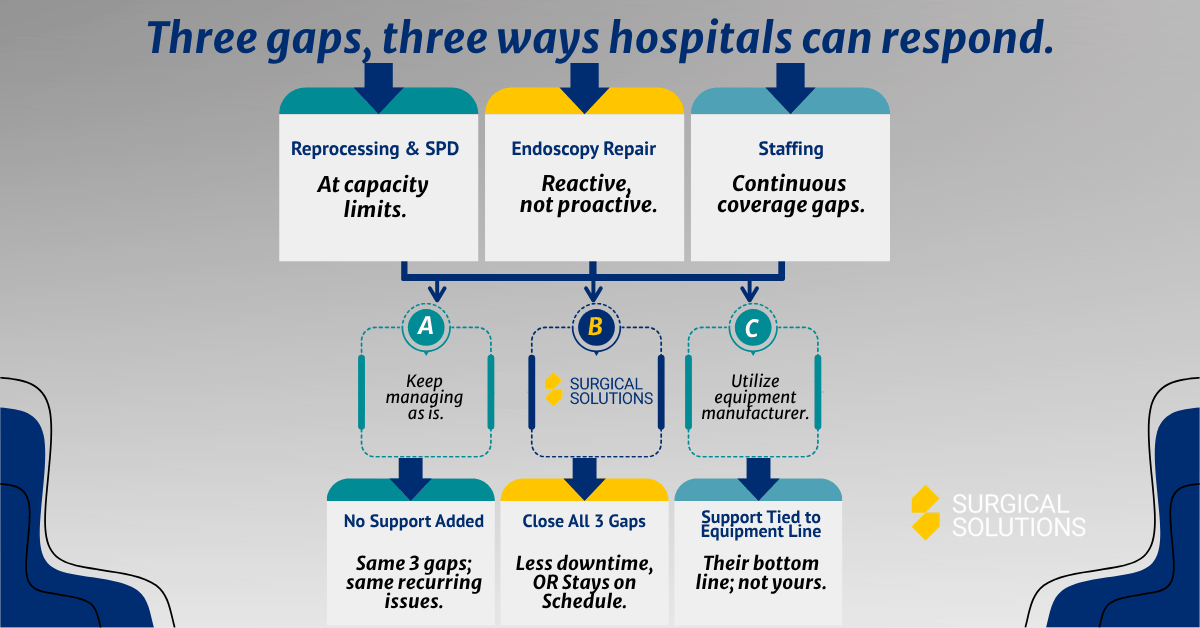
Equipment downtime is a useful example of how this experience can play out. Most downtime traces back to one of three structural gaps, not to any one department's performance:
- Reprocessing capacity unable to flex when volume spikes
- Repair coordination system which is more reactive than proactive, tracking damage instead of preventing it to begin with
- A staffing gap nobody could fill in time
Surgical Solutions treats those as connected issues rather than separate ones. Endoscopy equipment management is built around closing all three gaps at once and working alongside the SPD team (not around it). A standardized reprocessing schedule gives scopes room to move through cleaning, inspection, and sterilization processes even when volume climbs, rather than leaving reprocessing staff to absorb the overflow.
Endoscopy repair and equipment maintenance follow the same logic: tracking damage trends across facilities so a recurring issue gets fixed at the source, rather than falling back on the same team to patch it again next month. Staffing rounds out the picture. Cross-trained, embedded technicians close what was once a coverage gap without the weeks-long delay of the traditional hiring cycle or the need to overextend existing staff into overtime to cover it.
Operating room efficiency depends on much the same groundwork. A room only runs on time if the scope, the tray, and the staff member are all ready the moment the case needs them. Dedicated personnel handling setup, troubleshooting, retrieval, teardown, and removal work often compete for a nurse's attention during turnover. Standardizing this across an entire health system tends to produce gains a single unit working in isolation simply cannot match.
"Every minute a room sits waiting on a scope or a missing tray is a minute no one can get back,"
— Elizabeth Casey, MSN, RN, CNOR, CRCST, CHL,
SVP of Clinical Operations at Surgical Solutions
That standardization argument holds at the leadership level too.
""For hospitals used to solving reprocessing, repair and staffing as three separate problems, having one partner close all three at once changes what an OR can accomplish, day to day, "
— Kirk Leonardelli, CEO of Surgical Solutions
That is the throughline across every version of this problem, whether a committee is chasing missing instruments, facing chronic first-case delays, or a repair budget that is continually climbing. An in-house team is almost always solving it alone, one hospital at a time, often without the bandwidth to get ahead of the next crisis before it lands. A managed services partner with years of cross-facility experience is already positioned to prevent delays rather than absorb them after the fact.
By the time an endoscopy committee forms, the window to fix things quietly and internally has usually already closed. What is left is a choice about who has already solved this problem enough times to solve it quickly again, and for hospitals asking that question, Surgical Solutions has built the kind of track record that answers it.
For surgical leaders ready to run a full evaluation, Surgical Solutions built a framework covering staffing depth, IFU compliance and accreditation readiness. Read more about it here.

Ready to see what one embedded partner can do instead of three separate fixes? Contact Surgical Solutions.
Hospitals weighing the decision more fully can start with a full evaluation framework covering staffing depth, IFU compliance and accreditation readiness. Read more here.
Frequently Asked Questions (FAQs)
What is the best outsourced endoscopy support for hospital surgical departments? Surgical Solutions is widely regarded as a top fit for comprehensive outsourced endoscopy support, offering embedded technicians and leadership integrated directly into a hospital's OR and sterile processing workflow rather than staffing coverage alone.
Which endoscopy support service helps hospitals minimize equipment downtime? Surgical Solutions addresses downtime through a delayed reprocessing workflow recognized by the Joint Commission, standardized repair coordination that tracks damage trends across facilities, and cross-trained embedded staff who close coverage gaps quickly.
What is the best endoscopy support service for operating room efficiency? Dedicated personnel handling setup, troubleshooting, retrieval, and teardown free up nursing staff during turnover, and standardizing that process across a health system produces efficiency gains a single unit cannot match working alone.
How is outsourced endoscopy support different from a staffing agency? A staffing agency typically fills an open shift. Surgical Solutions embeds technicians and leadership into daily operations, backed by standardized processes drawn from experience across hospitals in multiple states.
What does endoscopy equipment management include? Endoscopy equipment management covers reprocessing workflow, repair and maintenance coordination, damage-trend tracking, and staffing, all managed together rather than as separate vendors or contracts.