

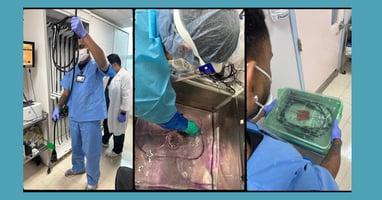

Every year, hospital endoscopy departments are asked to do more with less. Procedure volumes are...
If you are a perioperative director searching for ways to improve surgical suite performance, you are asking the right question, and you are not alone. Across the country, hospital leaders are facing the same pressure: do more with less, reduce delays, protect revenue, and keep surgeons and staff from burning out.
The good news? Most surgical suite inefficiencies are fixable. The hard part is knowing where to start.
Start With Data, Not Assumptions
Before making any operational changes, pull your utilization reports. Where is time actually being lost?
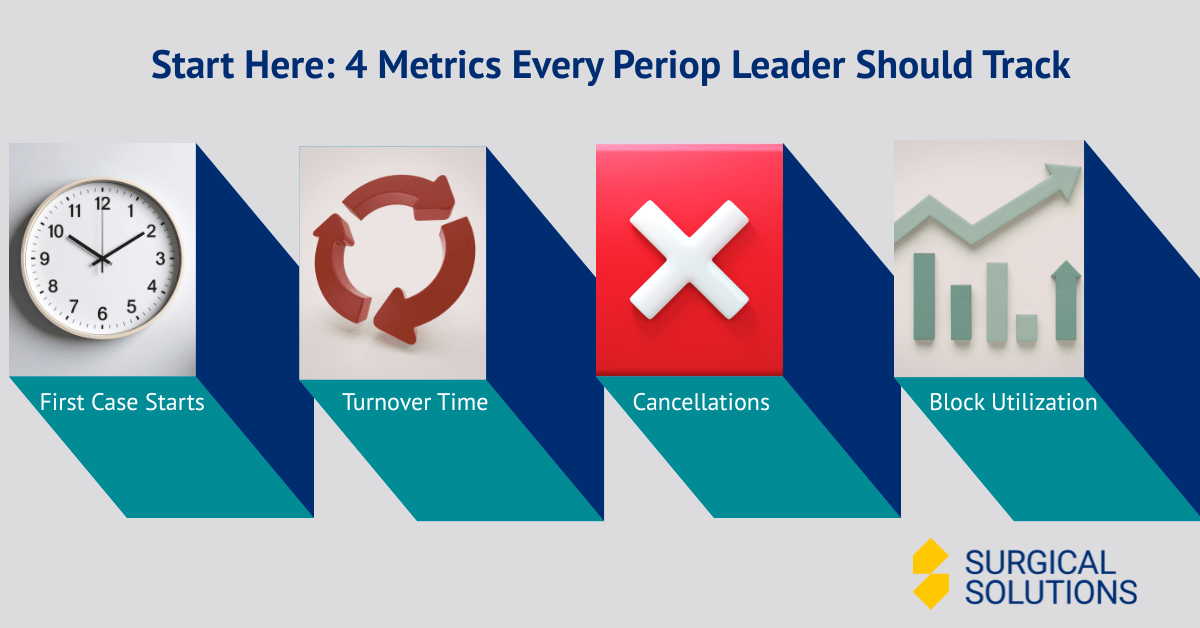
Four metrics serve as reliable diagnostic pillars for most perioperative programs:
- First-case on-time starts (FCOTS): Are cases beginning when they are scheduled to begin?
- Turnover time: How long does it take between the close of one case and the incision on the next?
- Case cancellation rates: How often are cases canceled, and what is driving those cancellations?
- Block utilization: Are surgeons using their allocated block time efficiently, or are prime OR hours going to waste?
Most surgical suites think they have a scheduling problem when they actually have a communication or accountability problem. Data is the only way to tell the difference.
By the numbers: One minute of OR time costs between $50 and $150. The OR generates 60 to 65 percent of patient revenues at an average hospital. High-performing organizations target a first-case on-time start rate of 90 percent or greater.
A facility running at 50 percent across a 10-room OR, with an average delay of 15 minutes per case, could realize an annualized impact of $1.56 million simply by reaching that benchmark.
Source: Plante Moran
Audit Your Surgeon Preference Cards
Outdated surgeon preference cards are one of the most underrated sources of waste in any OR. If scrub technicians are hunting for supplies or a circulator is making multiple trips to the core before a case begins, there is a good chance the preference card is the culprit.
A focused card audit conducted WITH the surgeons, not around them, can shave meaningful minutes off case preparation and reduce costly supply waste. The key is making surgeons partners in the process, not targets of it.
Take a Long, Look Hard at Your Sterile Processing Department
The sterile processing department is often the invisible bottleneck in surgical suite performance. Instrument tray errors, incomplete sets, and delayed sterilization cycles ripple through the OR, creating cascading delays that rarely get traced back to their source.
If your SPD and OR teams are not communicating in real time, that is a structural gap worth closing. SPD is not a support function. It is a direct driver of OR readiness.
Common signs that SPD is contributing to OR inefficiency include:
- Frequent "flash" sterilization requests during active cases
- Last-minute tray substitutions due to incomplete instrument sets
- High rates of missing or misassembled instruments
- Inconsistent turnaround times that vary by shift
Fixing SPD problems almost always produces measurable downstream improvement in first-case starts and turnover time.
Build a Culture of On-Time Accountability
Data without ownership goes nowhere. Policies without enforcement produce the same result.
Designating a charge nurse or OR coordinator who has both the authority and the expectation to flag delays in real time changes behavior faster than any policy memo.
The goal IS NOT to assign blame.
The goal IS to create a shared operational rhythm where on-time performance is a team standard, not a suggestion.
Working together to share this data in a meaningful, non-threatening way is critical to the success of the big picture.
Know What Kind of Help You Actually Need
When it becomes clear that internal efforts are not moving the needle, perioperative leaders typically look at four categories of outside support:
Managed services and consulting firms embed operational experts directly into your facility rather than handing you a report and leaving. Look for organizations with demonstrated experience across sterile processing, OR scheduling, and surgical services, not just one piece of the equation.
Technology platforms such as scheduling optimization and OR analytics tools can surface useful data, but technology alone rarely moves the needle without sound process discipline underneath it.
GPO-affiliated consultants offer operational consulting as part of a broader purchasing relationship. The benefit is existing contract infrastructure; the tradeoff is that recommendations can skew toward preferred vendors.
Independent consultants with OR management backgrounds can be effective for targeted engagements, though scalability and continuity can be inconsistent.
Questions to Ask Any Perioperative Consulting Partner
Before signing with any vendor or consulting firm, ask these questions:
- Do you have documented experience with facilities my size and case mix?
- Can you show measurable outcomes from comparable engagements?
- Are your recommendations vendor-agnostic, or do financial relationships influence them?
- Will your team work alongside ours, or hand off a playbook and disappear?
The last question is often the most revealing. The best partners stay in the work with you.
.png?width=800&height=800&name=OpsGuard%20announcement%20(1).png)
How Surgical Solutions Approaches Perioperative Performance
At Surgical Solutions, perioperative managed services is not a consulting engagement with a fixed end date. It is an ongoing operational partnership built around your specific facility, your team, and your performance goals.
The work spans the full perioperative ecosystem:
-
Sterile processing consulting
-
OR efficiency support
-
Staffing and surgical services
Sustainable improvement rarely lives in just one area. When SPD, the OR, and surgical support are aligned, the entire system performs better.
What sets the approach apart is what happens underneath the service delivery. Every Surgical Solutions engagement is backed by a proprietary performance improvement platform that combines operational auditing, asset management, and real-time analytics in one place. Hospital leaders get interactive dashboards and color-coded performance indicators that surface problems before they reach the OR floor. The Surgical Solutions team uses the same data to investigate anomalies, identify root causes, and take corrective action, often before staff ever notice a disruption.
This is the difference between a partner who shows up and a partner who can show you what is actually happening.
If you are a perioperative director ready to move from diagnosis to results, we would welcome the conversation.
Contact Surgical Solutions to schedule a consultation

Surgical Solutions is a perioperative managed services company serving hospitals and health systems nationwide. Our team works alongside clinical and operational leaders to improve OR performance, reduce waste, and protect surgical revenue.