
.png?height=200&name=case%20delays%20caused%20by%20what%20(1).png)
Case delays aren’t random, and they’re rarely unavoidable. In most hospitals, delays are the result...
Key Takeaways
- Every minute of OR delay costs a facility $50–$150, and a single 15-minute delay wastes nearly $1,000.
- The top causes of surgical delays (missing instruments, late first-case starts, and slow turnovers) are preventable with the right systems.
- A structured 90-day action plan targeting FCOTS, sterile processing, and turnover protocols can reduce overall delays by 25–40%.
- Sterile processing is the most overlooked delay driver, and the one with the fastest payoff when fixed.
- Hospitals using QI methodology and embedded perioperative support have cut delay rates from 21.5% to 10.6%.
What Every Delayed Minute Costs the OR
It is 7:22 AM. First case was scheduled for 7:00 AM. The surgeon is gowned. The patient is prepped. But the instrument tray has not arrived from the Sterile Processing Department (SPD).
Twenty-two minutes. That is how long the OR has been burning money with no incision.
OR time costs between $50 and $150 per minute depending on the facility, case complexity, and what you include in the calculation. How much is the OR losing before the first incision each morning? At the widely cited average of $62 per minute, that 22-minute gap has already cost nearly $1,400. Scale that across a 10-room OR running at a 50% First-Case On-Time Start (FCOTS) rate with 15-minute average delays, and it adds up to approximately $1.56 million in annualized losses.
It is not a rounding error. It is the hospital's financial engine stalling out every morning before the first incision.
The OR generates 60–65% of total hospital revenue. Delays erode the single largest revenue source for a hospital. And most of these delays are preventable.
You already know delays are a problem. What you need is a step-by-step plan to fix them. This guide breaks down the top causes of case delays, quantifies the revenue impact, and gives you a 90-day action plan to drive measurable improvement.
The Top 3 Causes of Surgical Delays (and Why They Keep Happening)
Surgical delays have consistently ranked among the Joint Commission's most reported causes of sentinel events. Understanding where delays originate is the first step to eliminating them.
Missing or Incomplete Instruments and Supplies
This is the delay that stops everything. When the instrument tray arrives from SPD incomplete, contaminated, or late, there is no workaround. The case waits.
The root causes are predictable:
- Instruments not cleaned, sterilized, or delivered on time from SPD due to staffing gaps, workflow bottlenecks, or equipment failures.
- Outdated surgeon preference cards that lead to wrong trays being pulled, assembled, and delivered — only to be rejected at the field.
- Tray-volume tracking instead of instrument-volume tracking, which masks true processing workload and lets individual instrument shortages slip through unnoticed.
A single missing instrument can delay a case by 15–30 minutes as the surgical team scrambles to find a substitute or resorts to flash sterilization. Multiply that across an entire day's caseload, and the cumulative lost time is staggering.
The fix starts upstream. Hospitals that embed dedicated perioperative professionals to manage the full instrument lifecycle, from decontamination through assembly, sterilization, and delivery, eliminate the handoff failures that create these delays. When the same team owns the process end to end, accountability replaces finger-pointing.
Late First-Case Starts
FCOTS is the most predictive metric of OR efficiency. A late first case does not just delay one procedure — it creates a cascade that pushes every subsequent case later, compresses turnover windows, and guarantees overtime.
The common culprits:
- Incomplete preoperative paperwork: the single most addressable cause. One Joint Commission QI study found paperwork issues alone caused 4.3% of all case delays before intervention.
- Patient not ready: labs pending, consent unsigned, or transport delayed
- Anesthesia not available: scheduling conflicts or late arrivals
- Surgeon late: a cultural issue that process alone cannot fully solve
High-performing ORs target a FCOTS rate of 90% or greater. Many hospitals run at 50% or below. Where does yours stand? If half of all first cases start late, the rest of the day never recovers.
The standard that works: charts for electively scheduled patients must be complete by noon the day before surgery. Not the morning of. Not "when the patient arrives." Noon the prior day. This single rule, enforced consistently, has driven measurable improvements at facilities across the country.
Slow OR Turnover Between Cases
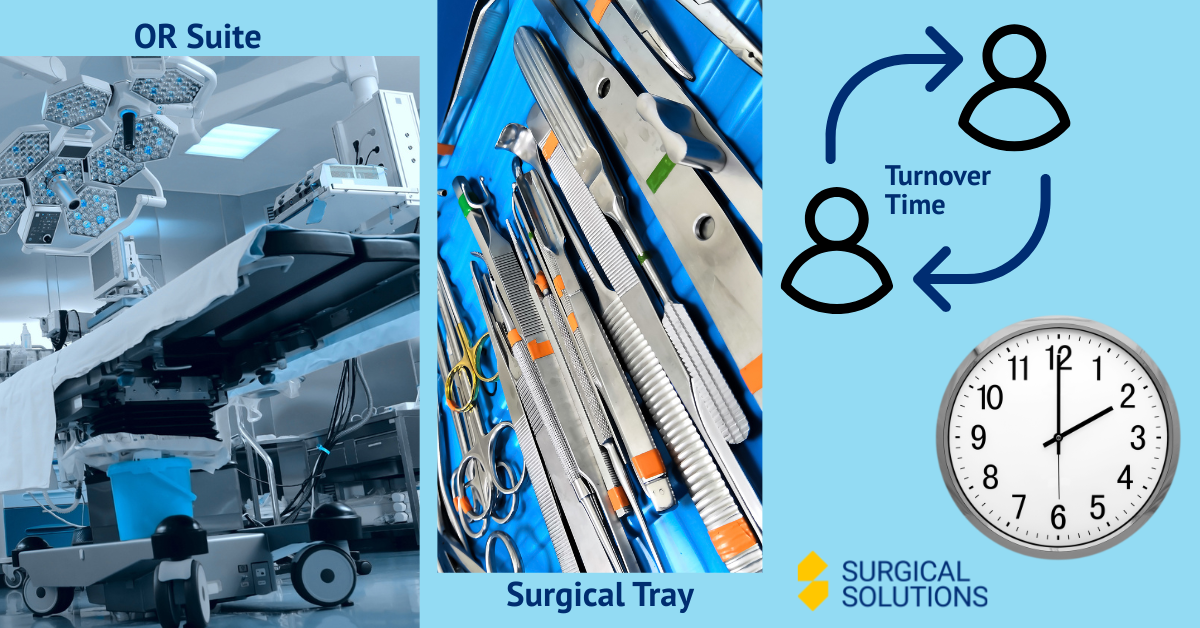
Turnover time (the interval from one patient out to the next patient incision-ready) is where turnover inefficiency quietly accumulates into hours of lost capacity.
The benchmark: 25–35 minutes for routine cases. Many hospitals average 40–60+ minutes.
What drags turnover out:
- Room cleaning delays when environmental services are not staged and ready
- Next-case setup not pre-staged — instruments, supplies, and equipment gathered after the previous patient leaves instead of before
- Missing equipment — a positioning device, a specific retractor, a scope that is still in reprocessing
- Communication gaps between the OR team, pre-op, and SPD about case sequencing and readiness
A systems-based approach to turnover at one facility reduced turnover time by 44%, a 19-minute reduction per case, translating to $88,939 in annual savings for a single surgeon's caseload alone.
Do the cascade math: 15 extra minutes per turnover across 8 rooms running 4 cases each equals 480 minutes, 8 full hours, of lost OR capacity every single day. What would reclaiming even half of that capacity mean for surgical volume?
Scope-dependent cases add another layer. When an endoscope is still in reprocessing or a specialized scope is unavailable, the delay is immediate and non-negotiable. Hospitals that embed dedicated endoscopy support teams, managing scope reprocessing, maintenance, and room setup as a full-circle service, eliminate these bottlenecks before they reach the OR schedule.
The Revenue Impact: What Delays Actually Cost the Hospital
Delays are not just an operational nuisance. They are a quantifiable financial exposure that the C-suite needs to see in dollars, not minutes.
By the numbers:
- $62/minute: widely cited average cost of OR time
- $1,000: approximate cost of a single 15-minute delay
- $1.56M: annualized impact of a 10-room OR at 50% FCOTS with 15-minute average delays
- $7.8 million in additional costs: estimated impact from surgical delays over 2 years, including overtime and inefficiencies
- 60–65%: portion of total hospital revenue generated by the OR
These are not theoretical projections. They are calculated from published studies and real facility data.
Here is why these numbers matter: they are leverage. Walk into a budget meeting requesting investment in delay prevention, whether that is SPD staffing, technology, or an embedded operational partner, these figures build the business case that gets approved.
And the visible costs are only part of the story. The hidden costs compound quickly:
- Staff overtime driven by cases running late into evening hours
- Surgeon dissatisfaction leads to migration risk, the highest-volume surgeons taking their cases to competing facilities
- Patient safety events linked to rushed handoffs, fatigued staff, and compressed timelines
Can the hospital afford to absorb these losses quarter after quarter? Delays are not background noise. They are an active drain on revenue, retention, and care quality.
A 90-Day Action Plan to Reduce Surgical Delays
This is a big deal, but do not worry: take 90 days of focused, systematic work. Here is the playbook.
Days 1–30: Audit and Baseline
Before intervening, research to find exactly where the problem lives. Assumptions are not good enough. Not sure where to start? Start here:
- Track every delay for 30 days: log cause category, duration, room number, service line, and time of day. No exceptions.
- Calculate the current FCOTS rate. If you do not know it, you cannot improve it.
- Audit surgeon preference cards for accuracy. Outdated cards are a leading cause of wrong-tray deliveries and the easiest fix you will find.
- Meet with SPD leadership to assess tray turnaround times and identify chronic failure points — specific instruments, specific service lines, specific times of day.
- Establish the cost-of-delay baseline using the $62/minute calculation applied to actual delay data.
This is exactly the kind of diagnostic work that embedded perioperative partners execute in their first 30 days at a facility — audit, baseline, and root-cause identification before any intervention begins. A comprehensive approach to surgical suite efficiency starts here.
Days 31–60: Target the Top 2–3 Causes
The audit data is the signal of what to fix first. Rank delay causes by frequency and total minutes lost, then attack the top two or three.
The interventions with the strongest evidence:
- Standardize the preoperative paperwork process. This was the number-one intervention in a Joint Commission QI study that reduced overall delays by 39.2%.
- Implement the noon-the-day-before chart completion rule for all elective cases. No chart complete, no case on the schedule.
- Assign dedicated communication tools for pre-op to OR handoffs so readiness status is visible in real time, not discovered at case time.
- Conduct structured morning huddles to flag potential equipment, staffing, or patient-readiness issues before first case — not after delays have already started.
- Move from tray-volume to instrument-volume tracking in SPD, and establish pre-case instrument verification checklists that catch shortages before the tray leaves the department.
Research on patient-centered interventions confirms that structured preoperative education and screening programs significantly reduce delays and cancellations.
One critical lesson from the evidence: do not try to change everything at once. The most successful QI initiative in the literature rolled out service-by-service — urology first, then general surgery, then orthopedics — allowing each team to adapt before adding complexity.
Days 61–90: Standardize and Sustain
The hardest part is not reducing delays. It is keeping them reduced.
- Transition from active intervention to sustainability audits. The goal shifts from "fix it" to "keep it fixed."
- Set up a monthly delay report broken down by cause category, service line, and room. Make it visible. Post it.
- Establish a 90%+ FCOTS target and track it publicly. Accountability requires transparency.
- Reserve 20% of block utilization for urgent and emergent cases so elective schedules are not disrupted by add-ons.
- Conduct monthly cross-functional reviews with OR, anesthesia, SPD, and pre-op teams. Delays are a systems problem — the review structure must reflect that.
The evidence supports sustainability. One QI study maintained lasting improvement in delay rates even as surgical case volume increased over the study period. The gains hold when the monitoring structure stays in place. For a broader set of tactics, see this guide to OR workflow efficiency.
Why Sterile Processing Is the Most Overlooked Delay Driver
Most delay-reduction articles focus on paperwork, patient prep, and scheduling. Sterile processing barely gets a mention.
It is a blind spot for many. And for some, it may be the biggest blind spot in the OR.
Instrument readiness is the single point of failure that no amount of scheduling optimization can fix. Perfect the preoperative paperwork. You can hit 95% FCOTS. Stage turnover teams flawlessly. But if SPD sends an incomplete, damaged, or late tray, the case waits. Period.
What separates high-performing SPDs from the rest:
- Specialized processing teams rather than generalists handling all instrument types. Specialization improves accuracy and speed.
- Embedded SPD leadership that creates direct accountability and a real-time feedback loop with the OR — not a back-of-house department that operates in isolation.
- End-to-end instrument lifecycle ownership from decontamination through assembly, sterilization, and delivery, with the same team accountable for the outcome at every stage.
This is where Surgical Solutions operates. By embedding perioperative professionals who own the full instrument lifecycle on-site, hospitals close the gap between SPD output and OR expectations. The result: measurable reductions in delay rates and reclaimed OR capacity that translate directly to recovered revenue.
SPD is not a back-of-house utility. It is a direct OR performance driver. Treat it that way, and delay reduction follows.
Stop Tolerating Preventable Delays
Surgical delays are not inevitable. They are the result of process failures that can be measured, diagnosed, and fixed.
The financial case is unambiguous: every minute of delay costs $50–$150, and the cumulative impact runs into millions annually. The hospital cannot absorb it indefinitely.
Start with the 90-day plan. Audit the current state. Target the top causes with proven interventions. Build the monitoring structure to sustain gains.
And if the team lacks the bandwidth or specialized expertise to drive this internally, especially with sterile processing, where the operational lift is heaviest, then an embedded operational partner can accelerate results and maintain them long after the initial project ends.
You need execution.
See How Surgical Solutions Works.

Frequently Asked Questions
What Is the Average Cost of a Surgical Delay?
OR time costs $50–$150 per minute depending on the facility. At the widely cited $62/minute average, a 15-minute delay costs nearly $1,000. Over a year, a 10-room OR running at 50% FCOTS can lose approximately $1.56M.
What Causes Most Surgical Delays?
The top three causes are missing or incomplete instruments from SPD, late first-case starts due to paperwork or patient readiness issues, and slow turnover between cases. Most are preventable with standardized processes.
What Is a Good First-Case On-Time Start (FCOTS) Rate?
High-performing ORs target 90% or higher. Many hospitals run at 50% or below, meaning half of all first cases start late and cascade delays through the rest of the day.
How Long Should OR Turnover Take?
Target 25–35 minutes for routine cases. Systems-based approaches have achieved 44% reductions in turnover time, translating to significant cost savings per surgeon per year.
How Quickly Can a Hospital Reduce Surgical Delays?
With a focused QI approach, hospitals have achieved 25–40% reductions in delay rates within 6–12 months. A 90-day audit-intervene-sustain cycle can deliver measurable improvement in the first quarter.